


- Provinces top
- Hokkaido
- Milky House in Churui
- Tokachi Station
- Suzuki-san - dairy farmer
- Kyodogakusha Shintoku
- Tohoku
- Ohsawa Onsen
- Tsurunoyu - hot spring
- Kanto & Koshinetsu
- Last concert in M-Uonuma
- Concert in Minami-Uonuma
- Tomaru pig farm
- Kofun in Gunma
- Inariyama Kofun
- Koma Shrine and Shoten-in
- Choshi - fish and soy sauce
- Narita Dream Dairy Farm
- Iwai - sea-bathing town
- Yokosuka - Mikasa and Curry
- Nihon Minka-en
- Hokuriku
- Noto Peninsula
- Yunode Ryokan
- Yuwaku Onsen
- Kanazawa
- Kansai
- Fushimi Inari-Taisha
- Home-cooking dishes in Kyoto
- Sannen-zaka and Ishibe-koji
- From Kitano to Shimogamo
- Kiyomizu and neighborhood
- Kyoto - then and now
- Imaicho - Time-Traveling to Edo
- Yamatai and Yamato
- Mount Miwa
- Asuka - cradle of Japan
- B&B Asuka
- Taima-dera and Princess Chujo
- Shikoku
- Yusuhara - a remote town
- Kochi - Sunday Market
- Himawari Milk Company
- Suigeitei - whale plate
- Kyushu
- Kumamoto Castle
- Wafudo confectionery
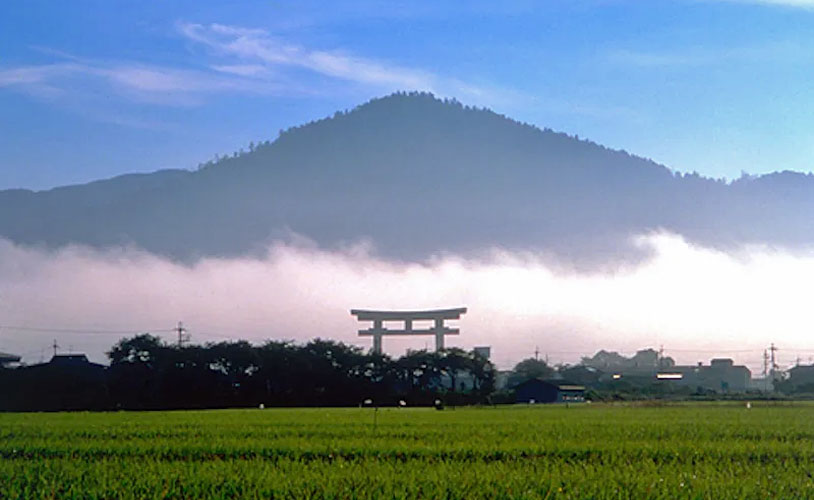
The Sacred Mount Miwa behind the torii of Oomiwa Shrine
Mount Miwa - The mountain that witnessed the birth of Japan
Mount Miwa is a beautiful conical mountain located near the center of the eastern side of the Yamato Basin.
According to the Nihon-Shoki (Chronicles of Japan), the oldest official historical record of Japan, the mausoleums of Emperor Sujin - regarded as the effective founder of the Yamato polity - and his grandson Emperor Keiko are situated not far from Mount Miwa. The Hashihaka Tomb, often considered the oldest keyhole-shaped burial mound (zenpo-koen-fun), is said to contain the remains of Princess Yamato Totohi Momoso Hime, a great-aunt of Emperor Sujin.
While it is difficult to accept the Nihon-Shoki accounts of the actual occupants of these tombs at face value, there can be little doubt that this area of the Yamato Basin was the birthplace of the Yamato polity that ultimately developed into the imperial line that continues to the present day.
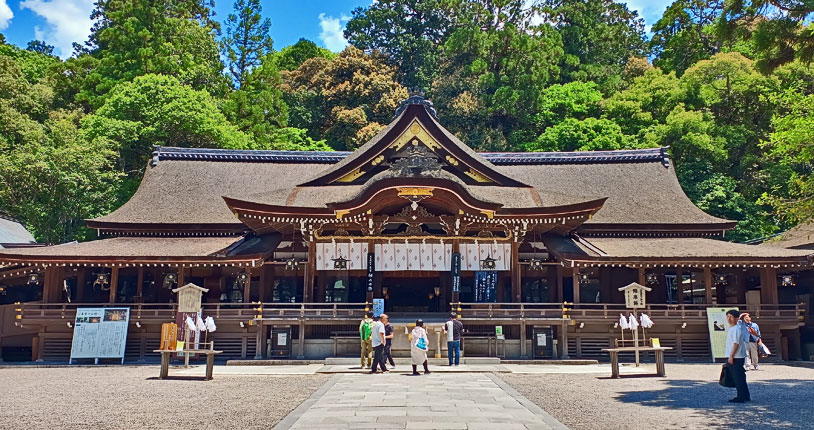
Worship hall of Oomiwa Shrine
At the western foot of Mount Miwa, on the side facing the Yamato Basin, stands Oomiwa Shrine. However, the building reached after passing through the shrine's torii gate is a worship hall (haiden); unlike most Shinto shrines, there is no main sanctuary (honden) enshrining a sacred object as the dwelling place of the deity. This is because, at Oomiwa Shrine, Mount Miwa itself - the mountain rising behind the shrine - is regarded as the sacred body of the deity. The shrine is therefore said to preserve a very ancient form of Japanese nature worship. Mount Miwa has been revered since remote antiquity, and it is believed that, probably in the early Yayoi period, the deity Omononushi came to be understood as residing upon the mountain.
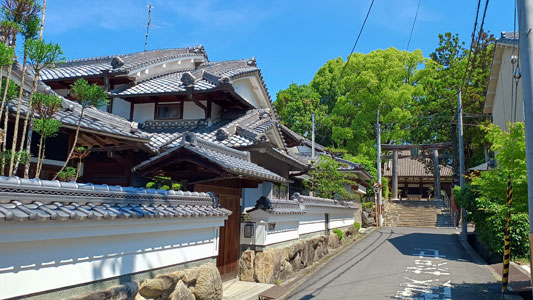
The path to Sai Shrine, where the pilgrimage starts.
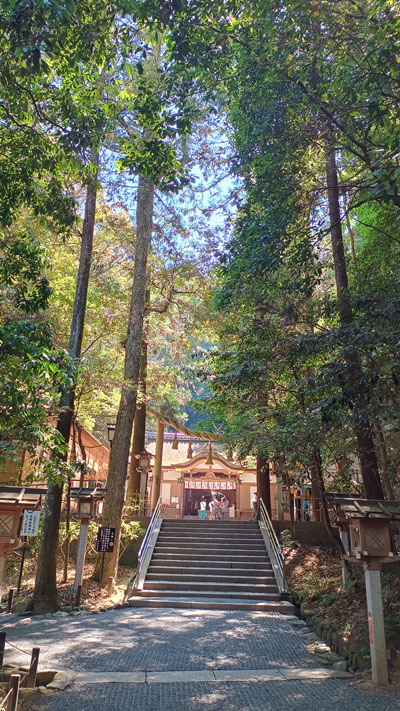
Sai Shrine, surrounded by forest
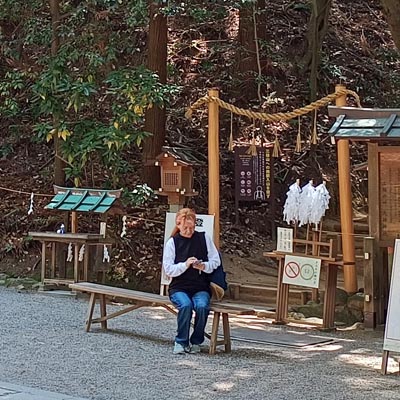
Entrance to the pilgrimage trail.

The Nihon Shoki, compiled under the Yamato court, clearly states that Omononushi-no-Kami, who began the work of nation-building in Izumo, extended his influence into Yamato and came to reside as a deity on Mount Miwa. This account serves as a necessary premise for the mythology of the transfer of the land from Okuninushi(identical with Omononushi) to the heavenly descendants as described in the Kojiki and Nihon Shoki. At the same time, however, it seems difficult to interpret it as anything other than a reflection of a memory that the Izumo power had once dominated this region before the establishment of the Yamato polity. While the relevant passages of the Nihon Shoki should not be regarded as literal historical fact, one may also ask why its compilers did not simply present a straightforward narrative in which the imperial ancestors descended from Takama-ga-hara and ruled Japan directly from Yamato. Perhaps it was because everyone at the time knew that the reality had been more complex.
The Omononushi of Mount Miwa appears in the chronicles as a deity possessing formidable spiritual power and capable of bringing various calamities upon the Yamato court. A well-known story relates that these disasters ceased only after the court located Ootataneko, said to be a descendant of the deity, and entrusted him with the proper rites of worship. Another famous episode concerns Princess Yamato Totohi Momoso Hime. According to the Nihon Shoki, she became the wife of Omononushi, but after offending the deity she met her death and was buried in the Hashihaka Tomb.
Whatever the precise historical truth behind these traditions, Mount Miwa was undoubtedly a mountain deeply loved and revered by the people of ancient Japan. In 667 CE, after Japan's defeat by the allied forces of Tang China and Silla in the Battle of Baekgang (Hakusukinoe), the capital was moved from Asuka to Oomi. At that time, the court poetess Nukata no Ookimi lamented having to leave behind Mount Miwa, the sacred mountain and symbol of her beloved Yamato, and composed the following poem. The Man'yoshu (The oldest collection of Japanese poetry, compiled in the 8th century.) contains dozens of other poems celebrating Mount Miwa as well.
-
Even Mount Miwa
must you hide it so completely?
O clouds, if only you had a heart?
how could you bear
to conceal it from our sight?
Because Mount Miwa itself is regarded as a deity, it was traditionally a sacred area into which ordinary people were forbidden to enter. Even today, that restriction has not been entirely lifted. However, those who obtain special permission and comply with the prescribed rules are allowed to climb to the summit and offer prayers to the deity.
I happened to learn of this opportunity only recently and decided to enter Mount Miwa - arguably one of the spiritual birthplaces of Japan - and reflect upon the origins of my country and its people. Photography is prohibited on the mountain, and visitors are instructed not to speak casually about what they see or hear there. In general terms, the ascent involves an elevation gain of about 400 meters from the entrance to the summit and takes roughly two hours for a round trip at an ordinary pace. Throughout the mountain are sacred rock formations (iwakura), objects of worship in ancient Japanese belief, hidden within primeval forest. Among these, the Okutsu Iwakura near the summit is regarded as the place where the spirit of Omononushi resides.
The origin of the name "Nippon" (Japan in the Japanese language) is now understood with a fair degree of certainty. By contrast, there is still no conclusive evidence as to when and how the Yamato polity, the foundation upon which the later Japanese state was built, first emerged. Was the Yamatai Kingdom described in the Records of Wei the beginning of the Yamato state? Did the Yamato polity arise by conquering Yamatai? Or is there an entirely different explanation?
Even with the aid of the latest scientific techniques, progress toward answering these questions has been frustratingly slow. Yet one thing seems clear: the birthplace of the Yamato polity lay on the eastern side of the Yamato Basin at the foot of Mount Miwa and the sacred mountain witnessed the birth of Japan. Simply standing here, one feels touched by the breath of a distant antiquity.
 2026.06.02